Showing posts with label Study. Show all posts

Saturday, June 13, 2015

Is it Working?

I committed my self to Big Gain Hunting this year.  I wanted to trade the most powerful moves in the most powerful stocks.  

Eric Muathe's Videos were very helpful and showing me how to narrow my focus to the strongest stocks.   Buy breakouts in the strongest stocks--- so simple, so effective.

  I've been seeing the market with more clarity than I ever had before.    There was a bit of a learning curve but my equity curve this quarter to date tells the story --17.28%


Friday, October 17, 2014

Reflections on One Crazy Week--5 day return 13.2% YTD: 53.81

Wow! We had a hugely volatile week: 


We had Ebola, We had melt downs, rallies.  I traded fast and furious and had my best week of the year-13.20%.  On a trade by trade basis, I probably had more losers than winners which is rare but I made my winners count.  Mean reversion was the name of the game.  XIV, HCLP.   But close behind was Ebola fever as I had trades in VRS and APT that saw a total of 20 minutes during regular trading.  After hours is great when stocks run to the A.M.

As I reflect on this week, I think my success is owed to the fact that I did not trust a single trade I made.  I had no problem getting out of trades as they were still going up.  I may have not hit homers but I hit a lot of doubles and triples that are rare in normal market trading conditions.

Any way here's the states:


This week looks great on my YTD returns as I close the week at my highest levels of the year.  Not too bad considering the overall market conditions.  My breakouts have had only marginal success since July.  

I need to be careful and lighten up off the gas.  All my biggest drawdowns, have come after my account has hit new highs and I thought I could bend my trading plans and rules.  To that end, I end the week with a beer and an account that is 95% in cash. Cheers.


Wednesday, July 2, 2014

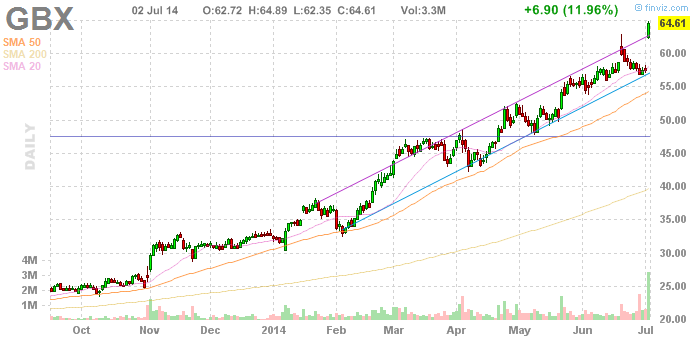
GBX: a train that won't slow down

So GBX blew out earnings and put up 12%.
I bought GBX last month at 56 and change.  But sold after the initial breakout failed as I did not want to give my profits back. Had I held my initial stop I would have still been in this trade.  I considered re-entry and and would considered it to have been a good entry point.  After reviewing GBX's recent past quarter earnings I noted a miss and some loss of traction.  As a result, I chose not to re-enter despite my belief that the industry was strong.  Since it was a calculated decision not to re-enter, I'm not that disappointed that I missed the earnings move.

So do  can I learn from missing this move?

GBX tells me however, that the "rails" are strong and the big driver  is because of domestic energy.  Oil is being shipped out and fracking sand is being shipped in.  Similar comments were expressed in UNP's CC which said shipments of Fracking sand was up 22% in Q1.

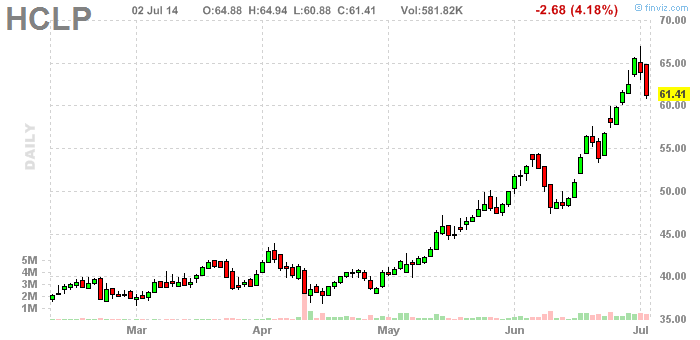
I have owned HCLP sub $38. It's had a great run despite the pullback today.  During the course, I've owned it it has had several of these significant pull backs. March, April and in June. Today's move in GBX tells me there is more left in the tank. I'll track UNP's earnings as well.  If positive, I would target EMES, SLCA, or HCLP on any significant pull back before earnings reporting as I believe there is substantial likelihood the results will be great.  If the railroads are buying more cars to service the fracking industry, the RR's will be more active as will the drillers.


Friday, June 20, 2014

Rule Changes


When I started this trade diary my rules were as follows:

I shall:
3. Use Hard Stops only
4. Calculate VaR Daily
5. Use Stop limits for Offense and Stop orders for defense.
6. Scale into positions.
7. Keep a Dairy of all positions
8. Continue to refine rules.

Pursuant to Rule 8.  I have changed several of my rules:

#3 Hard stops only.   I have recently read David Dreman's book as well as several trading blogs by people I greatly respect.  They have cautioned against hard stops with the advent of high frequency trading programs that are designed to search and destroy stops. I agree.  I have witnessed several flash crashes and cannot continue to recommend hard stops. 

 I now  believe that mental stops is the way to go. To ensure discipline, stops must be written out.  The difficulty is whether to execute immediatly upon breach or to wait if there is a close below that price.  I have seen mixed answers.  And for me it will remain discretionary.  In a highly liquid stock, a breach of the stop is more significant and should be sold immediatly.   In a thinly traded position, it is more susceptible for a flash crash unless news driven (which would require an immediate sale).  In Corn, for example, I witnessed  a big and furious sell off in the etf although the physical commodity that it tracks remained constant.  People that had hard stops got their pockets picked after the ETF recovered within 2 minutes. 

As a corollary to this rule, I believe stops should be set at the level where the theory for the trade would be disproven.  If the theory is a breakout and a breakout retreates in to consolidation the theory is disproven.  If I buy an anticipation set up and the stock trades the wrong way out of the consolidation, the theory is disproven.  No hopes, no justification, just get out. 

#5 Use Stop limits for Offense and Stop orders for defense.
If a stock is worth getting in get in via market.  If it is worth getting out get out via market.  trying to get top dollar on a limit order can get expensive if it misses. 

To track price set mobile alerts and then react 


Saturday, May 17, 2014

YOD: A company doomed to fail


 YOU ON DEMAND, ticker "YOD" has been pumped as the "Netflix of China."  But it's quarterly report demonstrate that YOD is not even the Netflix of China Town ... in Des Moines. 

I have repeatedly shorted this stock and did so again after earnings. I will continue to add to my position as the Quarterly Earnings report demonstrates that this company is doomed to fail.

Here is how I read the quarterly report of YOD and other pumped companies:
  • DETERMINE IF STOCK IS BEING DILUTED
    If a company is in a start up stage, you want to ensure that the insiders are committed to the long haul and not in it for a quick buck--the hall mark of a pump and dump.  So when I see a questionable company, I like to determine if and how much a stock is being diluted.  This will often take the form of convertible warrants and can be determined as follows:
Annual and quarterly reports will always list the number of shares outstanding as of the last date before issuance of an earnings report. The earnings data may in excess of a month a way.  This information lets you look into the future a bit.  

YOD is being diluted:
First page of quarterly report:

"Indicate the number of shares outstanding of each of the issuer's classes of common stock, as of the latest practicable date: 16,553,022 shares as of May 15, 2014."

Now let's compare that number since quarter end.  March 31, 2014.  We can do so by looking at the the Shares outstanding on the quarter.  An earnings report will compare quarters so we see that from March of last year that over 1.3  Million shares were added over the year:


       Basic15,931,39414,602,196
       Diluted15,931,39414,602,196

From the annual report, comparing 13 to 12:

Weighted average shares outstanding

       Basic

15,226,21611,099,746
       Diluted

15,226,21611,099,746


SINCE DECEMBER 31, 2013 the Shares outstanding have increased by 1,306,806.  This Stock is being diluted faster than a Dewars with two ice cubes. 
  • Assess Cash position and burn rate:  Obviously, you want to make sure the company has enough funds on hand to pay its bills and pursue its business strategy:
ASSETS
Current assets:
 Cash and cash equivalents$17,954,910$ 3,822,889


Wow, a huge increase in cash! YOD company must be raking in the profits right?  Not exactly.

Digging deeper we learn than it raised 25 Million dollars over the last year by issuing warrants.  They also sold off their broadband subsidiary. Of that, it now has about 18 Mill left.  Next, we determine whether the company is cash flow positive through ordinary operations:


Revenue$ 137,681$ 938
Cost of revenue875,938848,585
Gross loss(738,257)(847,647)
Operating expense:
       Selling, general and administrative expenses1,640,6401,983,736
       Professional fees185,484251,434
       Depreciation and amortization149,960292,833
Total operating expense1,976,0842,528,003
Loss from operations(2,714,341)(3,375,650)

*The 2013 earnings are a pro forma to account for a discontinued broadband business. (I'm somewhat skeptical of pro formas as companies can manipulate shares of the discontinued operations to show growth in the current business)   According to the YOD's annual report it list the discontinued operation as being profitable.  A question I have not answered yet is why they would get rid of their business that was at least marginally working?  But since that business is gone, I'll focus on the left over carcass. 

Currently, They currently lose money on every sale. They spend $8.75 for every $1.37 received    On top of that they have the other operating expenses which accounts for an additional loss of 1.9 M on the quarter.   At the current rate they'll lose 10.7 Million for the year. Leaving them with just $7.2 for next year.  YOD does not have sufficient cash to get through the next year.  
  • Is the Company's Business Plan working?
All companies hope that at some point they can generate sufficient revenues to cover the cost of revenue and the cost of operations and at some point even make a profit.  Given the struggles YOD has had I see little value in discussing profitability as it is not really relevant that the company has lost nearly $89 million since it began.  It's all about revenue growth.  It is imperative that the companies grow and given that there is less than 2 years of cash remaining, it is imperative that YOD grows very quickly.  Unfortunately, for YOD that is not what is happening.  Q4 2013, revenues were 163,000  and first quarter earnings were down to $137,681. YOD is clearly not growing as it had planned.
  • Will a new mobile business Strategy the Savior?
YOD apparently is of the belief that mobile will be the future.  It currently is on 1 cell phone, the Huawaei Mate and can provide up to 2 movies a week to subscribers. I seriously doubt that this strategy will work--are people really going to rent movies to watch on a 4 to 6"  screen?  I'm very skeptical. And  the revenue decrease demonstrates that this strategy is not working yet.  

Setting aside my skepticism and lack of tangible revenues, let's assume for the sake of argument that such a business plan is viable.  However, to implement this strategy it is imperative to advertise this new service, develop back end support, obtain the available servers and equipment necessary to run such a business.  In other words, to obtain mobile revenues YOD  requires a substantial additional investment.  Pursuit of mobile revenues will necessarily increase the company's losses.   And it does not have any margin for error, with the less than 2 years of cash it has remaining, which will mean to  company will need to raise cash causing more dilution.

In its own words:
 "we have access to additional funding through various methods including utilization of our $50 million shelf registration of which $47.3 million is remaining as well as other means of financing such as debt or private investment."
Just so no one is surprised when the next wave of dilution comes. And then the "going concern" notice. "These conditions raise substantial doubt about the Company’s ability to continue as a going concern."
The other "Analyst" --Chardan Capital-- has a $10 price target and recently opined that this could be a take over target.  I have not identified anything that YOD has that any potential suitor would not be able to acquire on their own for far less than $40 million.  

But Chardan and its executives own over 2 Million warrants.  (incidentally Chardan's founder is the brother of YOD's CFO March Urbach)  And the 10 price target is supposed to be objective, yea right. In addition,  In the quarterly report,  YOD discloses, "The Company is committed to paying service fees to certain consultants of $25,000 through the second quarter of 2014." 

Companies that pay for play, nearly always crash after the promoters have cashed out.  Given what we know about the ongoing dilution--nearly 9% year to date.  YOD is actively being sold and will be continue to be under tremendous selling pressure. 
  • The Competition is intense and the competitors are Goliath's
As I have pointed out on stocktwits, this notion that YOD has exclusivity or is a leader is a complete myth. Finally, YOD has acknowledged as much at the Conference Call:
The market for video entertainment is subject to continuous change and aggressive competition. Our primary competitors include companies that operate online video voice type in China, such as iQiyi, Youku, Tencent and Sohu. They all carry a very large amount of the video content, including Hollywood and domestic movies and they compete on the variety and freshness of the content, in order to drive Internet traffic to their websites. 
YOD is competing against companies that are worth many billions of dollars with the same content.  Who has the infrastructure and ability to spend money on advertising?  YOD will lose that battle. 
Conclusions

  •  The Q1 report suggests that YOD is doomed
  •  Revenues are decreasing, 
  • YOD losses money on each sale
  • YOD does not have sufficient cash to get through the next year. 
  • More dilution is likely
  • Insiders will continue to exercise warrants keeping YOD under pressure
  • It will need substantial additional funds to pursue its mobile strategy.  
  • Competition is intense and YOD offers nothing to consumers that Chinese Internet giants do not already have.
Nonetheless, some people spent 15 minutes reading an article on seeking alpha, by an anonymous author who created his profile the day he published his first article which calling YOD the Netflix of China. Based on that pump, they continue to think will become a double and triple digit company. I plan to go point by point through that nonsense, but my conclusion is don't buy the hype. 

Monday, May 12, 2014

Technical Analysis Doesn't Work... But I use it anyway.

Study after study has demonstrated that technical analysis doesn't really work. For example, an October 2009 study by New Zealand's Massey University tested more than 5,000 technical analysis strategies in 49 different countries. The result? Not one strategy generated returns that aren't predicted by chance.   

Sure we can point to one stock that had the perfect text book breakout.  But then if we think back over our trades we will see just as many failed breakouts.  KBH is one that I had.   In KBH we had a nice breakout over $19.50, a continuation the next day up over $20.70  and then total failure past the point of breakout... past the consolidation area.  


As studies show, a "good chart" is just as likely to make for a losing trade as a "bad chart."    I think as a whole, it tends to make traders lazy.  It seems like these days everyone is an expert at technical analysis.  Yet very few know how to read a balance sheet and even fewer constantly make money trading.


In one of the more interesting studies that I've seen, it was demonstrated that the buy strategy  matters far less than the sell strategy.  Using coin flips to enter a trade, you could still make money with well defined exits. This is interesting because there are hundreds of websites recommending stocks to buy and focusing on buy strategies.  Yet it is the sell strategy that  generates the returns.  Notably,  famed commodities trader Peter Brandt estimated that his gains were from just a few trades a year:

  • Expect the bottom line over an extended time frame to be represented by only 10% of all trades. The other 90% of trades will be washes.
 His gains can be attributed to risk management as he avoided the large losses.  His record of successes  is  reduced to the maxim "cut your losses short and let your winners run."  

HOW I USE TECHNICAL ANALYSIS

Although I'm of the opinion that Technical Analysis does not work (and I find it comical when people say that a stock has to break a precise penny amount to breakout) I do find it helpful in a following regards:

1. Am I buying value or am I chasing.

I prefer to buy pre-breakout and take my chances that the stock eventually will breakout to the upside.  Given that buying breakouts provides  no more statistically significant profit probability than any other movement, I would rather buy in an area where others have found value, I.e. a consolidation area. This gives me room for error.  I also like to sell a portion of the position off into any breakout, which hedges me against a false breakout and exposes me to less risk.  The downside of such an approach is that I may be in a stock for an extended period while it is in sideways range.  If it does begin an up move, this works to my benefit for tax reasons if I can hold in excess of a year my tax rate is significantly reduced.

2. Am I buying strength or weakness?

All things equal, stocks that have performed are more likely to continue to perform. I'd would rather being in a stock that is going up than down. I would rather buy stocks outperforming the market  on a temporary weakness than attempting to exploit an over-reaction. Reversion strategies such gap filling work well until the one time they don't... and the losses are massive when those strategies don't work.    

On a trending stock, I would prefer to buy a pull back to the middle of the trending range (or short the inverse).  To trade reversals, I want to see an extended bottom, which tells me others are finding value in the range. A sharp stab downwards, is a falling knife and the risk is extreme of both more down side or a quick upside. That becomes just gambling that does not permit adequate risk management.

3. Am I managing my risk?


One of the best pieces of advice that I have seen regarding risk management is that your stop should be placed at the level that disproves your theory. You then position size accordingly.  

If I think a stock is going to breakout to the upside I would place a stop at the level that disproves my hypothesis. In my opinion, its fine if a breakout fails and gets sucked back into consolidation area where people have been supporting the stock.  I should be in already with room to spare, even if this happens I will be in a decent position. It's the break to the downside of the consolidation zone that cause me to exit. 

For example, In my XCO trade I was in in the $5.80s. This had the possibility of presenting a multi-month bottom, which can produce huge returns.  For that reason, I didn't sell after a nice pop to 6.60. Had I looked for a shorter term move, I would have.  I also would have taken more size on the trade but I digress.  After a month of consolidation between $5.75 and $6.25, (an area where traders were finding value) it broke hard to the downside. My theory that a multi-month move to the upside was beginning was disproven and I took my loss.


 I've seen too many people on Stock Twits, or the like, who attempt to justify a losing trade (and their  refusal to take a loss) based on TA. This practices will destroy your account.  Your exit needs to be known before you enter.

Conclusion

Despite this criticism, technical analysis has its place. Stocks that begin big moves have similar looks to them before they start.  For that narrow reason, technical analysis can help weed through the stock universe to find candidates that have "that look to them.  Given enough chances some will hit.  Peter Brandt's approach results from him being in the commodities than are beginning runs,  not taking big loses. Combined with proper risk management procedures you can avoid the risk of big losses.  Thus, keeping you in the game giving you more chances to be in the stocks that run.  It's that simple... cut losses short, and let winners run.

Most Investors are Gamblers

It is important to know your opponents.  Most investors just play hunches:
If they’re not relying on investment knowledge, investors are playing the market the way most people bet at the track or in the casino, by playing hunches. Nearly 80 percent of investors surveyed by Natixis said they simply follow their gut instinct.
When a stock moves in their favor all is fine and well but when it moves against them they seldom have a plan to deal with sell off.  They hold on far too long.  Perhaps it is for this reason, stocks overshoot valuations on both the upside and downside.